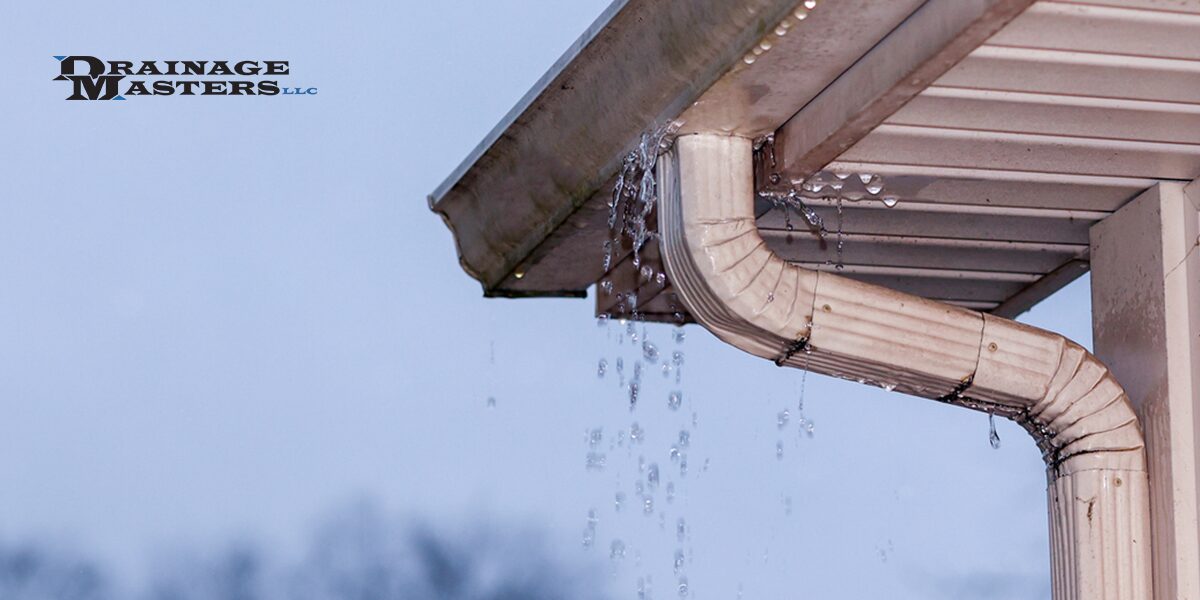
You notice it before you can explain it. A musty smell drifts up from the crawl space, a damp patch spreads across the basement wall, and a stretch of lawn never quite dries out. Most homeowners check for leaky pipes or rising groundwater, but the source may be your roof’s drainage system.
Roof drainage problems rarely announce themselves. When gutters overflow or downspouts empty in the wrong place, each Pacific Northwest storm can push moisture toward your foundation instead of away. With annual rainfall often reaching 40 inches in the Portland area, a compromised system works against your home with every downpour.
When gutters are undersized, clogged or improperly routed, roof runoff dumps at the base of your home instead of draining away. Homes with roof drainage in Portland, OR, and the surrounding area face a particular challenge, since the region’s clay-heavy soil resists natural drainage and holds water against the foundation.
That saturation creates hydrostatic pressure against foundation walls, pushing moisture through cracks and joints until an unaddressed gutter drainage fix becomes a foundation problem underground.
By the time you notice cracks, moisture stains or a musty smell, the saturation has usually built up for months. Once water reaches your crawl space drainage system, it can bring mold growth, wood rot and insulation damage.
Most foundation and crawl space moisture problems trace back to one of four roof drainage failures.
Gutters sized for average rainfall can’t keep up with Pacific Northwest storm volumes. A 2,000-square-foot roof sheds roughly 1200 gallons per inch of rain, and when a gutter overflows, water cascades off the roofline against your foundation instead of channeling away. Improper pitch causes the same result — a gutter that doesn’t slope correctly toward the downspout pools water until it spills over.
Gutter cleaning and replacement fall outside the scope of most roof drainage waterproofing plans, but a gutter that keeps backing up often signals that the downstream system needs professional evaluation. Taking time each fall to prepare your home for the rainy season can catch these issues before the heaviest storms arrive.
A blocked downspout backs water up into the gutter, overflowing at the edges and depositing runoff along the foundation line, and leaf debris is usually the culprit in fall and winter. The result is a downspout drain pipe that directs heavy runoff toward the foundation during every rain event.
High-pressure jetting, paired with a camera inspection, can diagnose and clear blocked underground rain drain lines. A qualified roof drainage contractor in the Pacific Northwest can use diagnostic tools to pinpoint where a blockage is forming and provide solutions.
The downspout itself works fine, but it deposits water only 1 to 2 feet from the foundation instead of the required distance, making it one of the most overlooked problems in the system. Building science standards call for surface extensions to be at least 5 feet from the foundation, or for underground systems to be set back at least 10 feet.
The EPA recommends similar spacing when disconnecting downspouts, and Portland has its own separate requirements for basements and crawl spaces.
Portland code requires discharge 6 feet from basement walls and 2 feet from crawl spaces, and even a functioning downspout that empties too close to the house can saturate the clay soil and drive moisture toward the foundation. Disconnected downspouts also need proper extensions after the standpipe is capped, or roof runoff can still collect too close to the foundation.
Many Pacific Northwest homes have underground drain lines connecting downspouts to a discharge point or dry well, and over time, these lines can crack, settle or become blocked by roots and debris. When they fail, water dumps into the soil beside the foundation instead of draining away. This underground downspout failure in Portland stays hidden below grade, which is why clogged gutters and foundation damage so often go undiagnosed until symptoms appear inside the home.
A thorough inspection of your roof drainage system can pinpoint cracks, root intrusions and blockages before they cause lasting damage. Homeowners who need downspout extensions in Vancouver, WA, can access the same diagnostic approach across the river.
A properly functioning downspout extension carries water far enough from the foundation that the region’s clay soil can’t route it back toward the house. The same building science standards covered earlier apply here, with a slope of at least a quarter inch per foot below ground.
For many buried lines, solid PVC pipe can be a better option than corrugated pipe because the ridged material may collect debris or collapse over time. At the surface, splash blocks or rip-rap help control erosion around the outlet, following common guidance throughout Clark County and Vancouver, WA.
Getting these basics right matters for any gutter drainage solutions you’re considering, and choosing the right drainage system starts with knowing what correct installation looks like.
Instead of a visible extension that deposits water a few feet from the house, underground downspout routing carries roof runoff through a buried line to a discharge point well beyond the foundation. That line connects at the downspout, runs on a continuous downward slope and empties at a daylight outlet, a dry well or a storm sewer connection.
Aging rain drain systems throughout the Pacific Northwest frequently need rehabilitation, since cracked, settled or root-intruded pipe can deteriorate for years without visible warning. Camera inspections pinpoint the problem before any excavation begins, and roof drainage solutions can help keep the issue from spreading.
Left unresolved, a compromised line can contribute to basement and crawl space moisture problems, since both areas are affected by the same saturated soil.
A dry well is an underground chamber surrounded by gravel that receives roof runoff and disperses it into the surrounding soil, keeping water away from your foundation instead of letting it pool. This kind of dry well drainage is especially valuable in Pacific Northwest clay-heavy soil, where surface discharge alone may fall short on some properties.
Placement matters just as much as the chamber itself. The dry well needs to sit at least 10 feet away from the foundation, be connected by a sloped inlet pipe and be sized for the roof area it serves. Effectiveness depends on how the soil accepts infiltration, so some properties may need a larger or better-positioned system.
A professional assessment determines what fits your property, and dry well installation tailored to your home’s conditions works better than a one-size-fits-all approach.

Once you understand where your drainage problems are coming from, reaching out to a team that’s served Pacific Northwest homeowners since 1996 is the natural next step. Drainage Masters LLC knows how quickly a small roofline issue can turn into a foundation or crawl space headache, which is why every project starts with a free, on-site estimate that pinpoints what your property needs rather than a one-size-fits-all fix.
From downspout repairs to full underground rerouting, our roof drainage services come backed by warranties that protect your investment for years. Give us a call or fill out our online form for your free estimate.

